⏱️ Reading time: 9 min
SeoulTech, the Seoul National University of Science and Technology, presented a framework designed to expose the exact moment when an artificial intelligence vision system stops recognizing what it should recognize. The tool measures and seeks to improve AI vision robustness against noise, blur, compression, and perturbations calculated to fool the model.
📑 En este artículo
The report, published by TMCnet, arrives at a moment when security cameras, driver assistance systems, and medical diagnostic equipment increasingly rely on neural networks trained on clean images that rarely reflect real-world usage conditions.
TL;DR
- SeoulTech (Seoul National University of Science and Technology) presented a framework to measure AI vision robustness.
- The framework applies adversarial perturbations and natural corruptions (noise, fog, compression) to test images.
- It measures the model’s accuracy drop against these alterations and feeds it back into retraining.
- It builds on the same line of work that popularized FGSM (Goodfellow, 2014) and the ImageNet-C benchmark (Hendrycks, 2019).
- Open tools like RobustBench and torchattacks let you reproduce similar tests today.
- Robustness is increasingly a regulatory requirement for high-risk AI systems, not just an academic metric.
- The main trade-off: improving adversarial robustness usually lowers accuracy somewhat on clean data.
What Happened
According to TMCnet’s coverage, the SeoulTech team built an evaluation framework that subjects computer vision models to a set of automated tests before they go into production. The core idea isn’t new: it comes from a research line that started more than a decade ago, but SeoulTech packages it as a repeatable process an engineering team can run against its own model, similar to a continuous integration pipeline that runs unit tests before a deploy.
The framework combines two families of tests. The first applies adversarial perturbations: mathematically designed noise, nearly imperceptible to the human eye, that exploits the model’s own gradient to maximize classification error. The second applies natural corruptions: fog, rain, motion blur, aggressive JPEG compression, conditions a real camera can encounter without anyone attacking it. A model can perform well on both tests, on just one, or on neither, and that combination defines its AI vision robustness in practice.
What makes a framework like this useful isn’t just detecting the failure, but feeding that result back into training: the images that break the model are used to generate data augmentation examples or for an adversarial training regimen, partially closing the gap between lab accuracy and real-world accuracy.
Context and History
The starting point for this field is usually set in 2014, when Ian Goodfellow and his co-authors published the FGSM (Fast Gradient Sign Method), which demonstrated that adding nearly invisible noise to an image could make a state-of-the-art neural network classify it with total confidence as something completely different. That fragility, counterintuitive for a system that outperformed humans in raw accuracy, opened up an entire subdiscipline within machine learning.
In 2019, Dan Hendrycks and Thomas Dietterich published ImageNet-C, a benchmark that instead of attacking the model with adversarial math subjects it to fifteen types of everyday corruption (Gaussian noise, pixelation, fog, brightness changes, among others) at five severity levels. The paper’s conclusion was uncomfortable: models that already outperformed humans on clean ImageNet collapsed against corruptions a human wouldn’t even notice. That finding is, in essence, the problem a framework like SeoulTech’s tries to solve systematically.
Since then, efforts like RobustBench have joined in, an academic leaderboard comparing dozens of models under standardized attacks and corruptions, along with programs like DARPA’s GARD (Guaranteeing AI Robustness against Deception) in the United States, focused on mathematically certifying a model’s robustness limits, not just measuring them empirically.
Technical Details: How AI Vision Robustness Is Measured
The central metric in any evaluation of this kind is robust accuracy: the percentage of images the model still classifies correctly after a perturbation or corruption is applied, contrasted with clean accuracy measured on the original, unaltered dataset. The difference between the two figures exposes how fragile a model really is in practice.
| Test Type | Example | When to Use It | Limitation |
|---|---|---|---|
| Adversarial perturbation (FGSM, PGD) | Noise calculated using the model’s gradient | Assess risk against a targeted attacker | Almost always requires white-box access to the model |
| Natural corruption (ImageNet-C) | Fog, motion blur, JPEG compression | Assess robustness against real camera or weather conditions | Doesn’t represent a malicious attacker |
| Distribution shift (domain shift) | Images from a different camera, country, or dataset | Assess generalization outside the training set | Hard to summarize in a single metric |
Something that tends to surprise people outside the field: you don’t need physical access to the camera or the production pipeline to attack a model. Knowing its architecture, or even just its output in black-box attacks, is enough to generate perturbations that work consistently against the same family of networks.
A typical pipeline for this kind of framework follows a simple cycle: generate the perturbation, measure the accuracy drop, and, if the result is poor, feed it back into training.
flowchart TD
A["Original image"] --> B["Perturbation generator"]
B --> C["Vision model"]
C --> D["Measure robust accuracy"]
D --> E{"Does accuracy drop?"}
E -->|"Yes"| F["Retrain with augmentations"]
E -->|"No"| G["Model approved"]
F --> C
How to Start Testing It
You don’t need to wait for SeoulTech to publish its framework to start measuring the AI vision robustness of your own model. The open source community has already built the necessary pieces, and running a first test takes minutes.
pip install torch torchvision torchattacks robustbenchWith that installed, the minimal flow is to load a pretrained model, apply a known attack, and compare accuracy before and after.
import torch
import torchvision.models as models
from torchattacks import FGSM

model = models.resnet18(weights="IMAGENET1K_V1").eval()
atk = FGSM(model, eps=8/255)

adv_images = atk(images, labels)
outputs = model(adv_images)
robust_acc = (outputs.argmax(1) == labels).float().mean()
print(f"Robust accuracy: {robust_acc.item():.2%}")
The eps parameter controls how much the noise is allowed to shift each pixel: low values generate nearly invisible perturbations, high values are easier to spot at a glance but also easier to block with simple filters. For natural corruptions instead of targeted attacks, the imagecorruptions library replicates the fifteen types defined in ImageNet-C without needing access to the model.
💡 Tip: The eps parameter in FGSM or PGD is usually tested in a range from 2/255 to 16/255. The higher it is, the easier it is to fool the model, but the less realistic the perturbation becomes.
Impact and Analysis
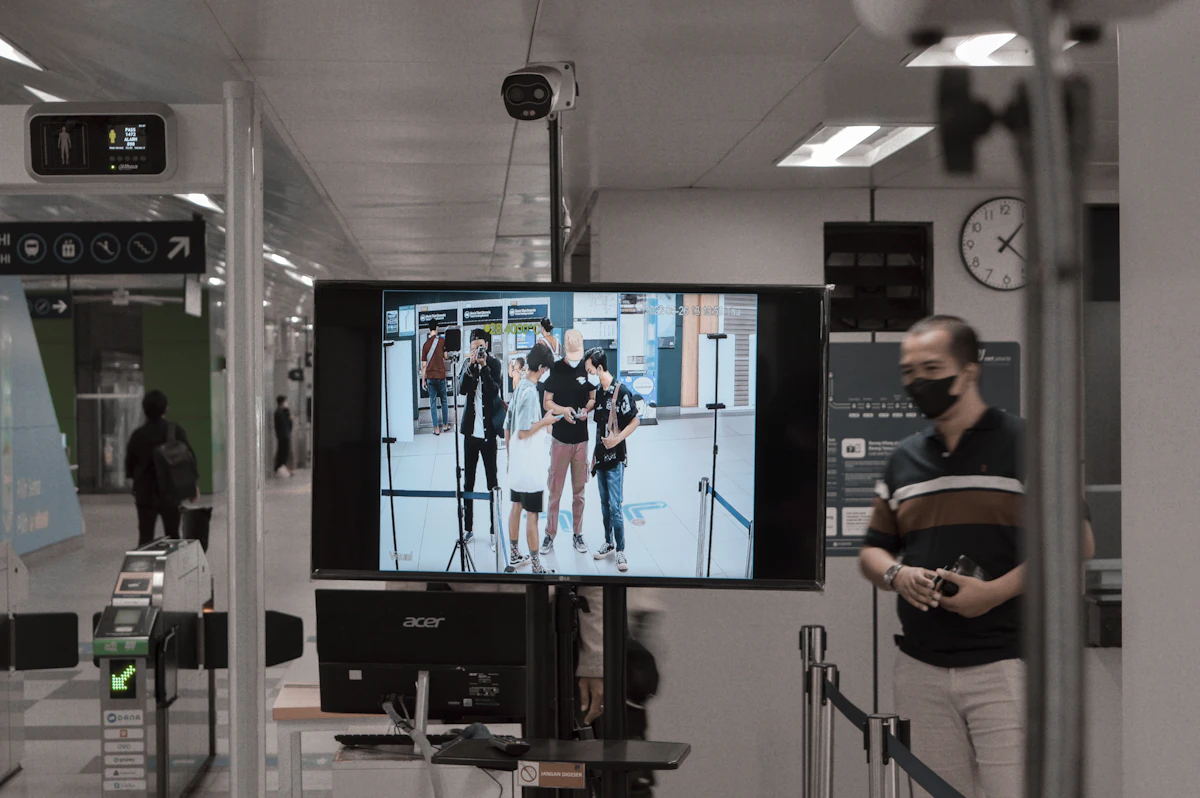
AI vision robustness stopped being a purely academic topic. An automatic braking system that fails to recognize a stop sign partially covered in snow, or an access control camera that an attacker fools with a printed pattern on a cap, are the same problem these benchmarks document, only with physical consequences.
That’s why frameworks like this are becoming part of the development process, not a separate experiment: running them before every deployment lets teams catch robustness regressions the same way an integration test catches a functional regression.
⚠️ Heads up: Training a model to resist adversarial attacks almost always reduces some accuracy on clean data. There’s no free robustness: it’s a trade-off that needs to be measured, not assumed.
The cost isn’t just computational. Adversarial training, the most common technique for closing the gap between clean accuracy and robust accuracy, can multiply training time because each data batch first requires generating its attacked versions before updating the model’s weights.
What’s Next
The regulatory trend points toward these tests no longer being optional. Frameworks like the European Union’s for high-risk artificial intelligence systems already include accuracy, robustness, and cybersecurity requirements as a condition for operating in sensitive sectors, pushing evaluations like SeoulTech’s from an academic paper toward a mandatory step before launch.
On the technical side, the field is moving toward formal certification: instead of just testing against a handful of known attacks, certified robustness techniques try to mathematically prove that no attack within a given radius can change the model’s prediction. It’s a much higher standard than beating a benchmark, and it’s still expensive to apply to large models.
Try it yourself: install torchattacks and run an FGSM attack against your own vision model before your next deploy to see how much its accuracy actually drops.
Frequently Asked Questions
What is AI vision robustness?
It’s a computer vision model’s ability to maintain its accuracy when the input image changes slightly, whether from natural noise (fog, compression) or from a perturbation designed on purpose to fool it.
Are an adversarial attack and a natural corruption the same thing?
No. An adversarial attack uses the model’s gradient to calculate the most damaging noise possible; a natural corruption simulates real camera or weather conditions without malicious intent. Both can lower accuracy, but they’re measured and fixed differently.
Can I evaluate my own model’s robustness today?
Yes. Open libraries like RobustBench and torchattacks let you run FGSM or PGD attacks against any torchvision model in a few lines of code, as shown in the How to Start Testing It section of this article.
Does improving adversarial robustness affect normal accuracy?
Almost always, to some degree. Adversarial training tends to slightly reduce accuracy on clean data in exchange for a much smaller accuracy drop against attacks or corruptions.
Where is this applied outside the lab?
In systems where a vision failure has physical or safety consequences: driver assistance, camera-based access control, industrial inspection, and medical image diagnosis.
References
- TMCnet: report on SeoulTech’s framework for AI vision robustness.
- arXiv: Explaining and Harnessing Adversarial Examples: the Goodfellow et al. paper that introduced FGSM in 2014.
- arXiv: Benchmarking Neural Network Robustness to Common Corruptions and Perturbations: the paper that introduced ImageNet-C.
- RobustBench: open leaderboard comparing models under standardized attacks and corruptions.
- Wikipedia: Adversarial machine learning: general overview of the field and its techniques.
📱 Enjoy this content? Follow @programacion on Telegram for daily tech content in Spanish: quick summaries, fresh content every day. @programacion
Imagen destacada: Foto de Kevin Ku en Unsplash
Did it work for you? Got a different error? Say so below: questions get answered and help the next reader.
Leave a comment
0 Comments