⏱️ Reading time: 9 min
An artificial intelligence model can now detect the signals that precede a solar flare hours in advance, according to a report from Phys.org. Until now, most warning systems only confirm a flare once it’s already underway, or alert about a coronal mass ejection just minutes before it hits Earth.
📑 En este artículo
Gaining hours instead of minutes changes the game for those operating satellites, power grids, and polar flight routes. This article explains what solar flares are, why they’re so hard to predict, and how artificial intelligence is tackling that problem.
TL;DR
- A new AI model detects signals ahead of solar flares hours in advance, according to Phys.org
- X-ray sensors on GOES satellites only confirm a flare once it has already started, with no advance margin
- Probes at the L1 point (ACE, DSCOVR) give between 15 and 60 minutes of warning once the ejection is already traveling toward Earth
- The new approach analyzes magnetograms, maps of the Sun’s magnetic field, to find patterns preceding the flare
- More hours of warning allow protection of satellites, power grids, and polar flights before impact
- NASA and NOAA publish open solar data (DONKI, SWPC) that any developer can query today
- The advance adds to the trend of using AI as a scientific reasoning tool, not just a data analysis one
What happened: an AI detects solar flares ahead of time
The report describes a model trained to recognize subtle patterns in the Sun’s magnetic activity before a flare or a coronal mass ejection (CME) occurs. The key difference lies in the timing of the alert: traditional systems measure the flare while it’s happening, not before.
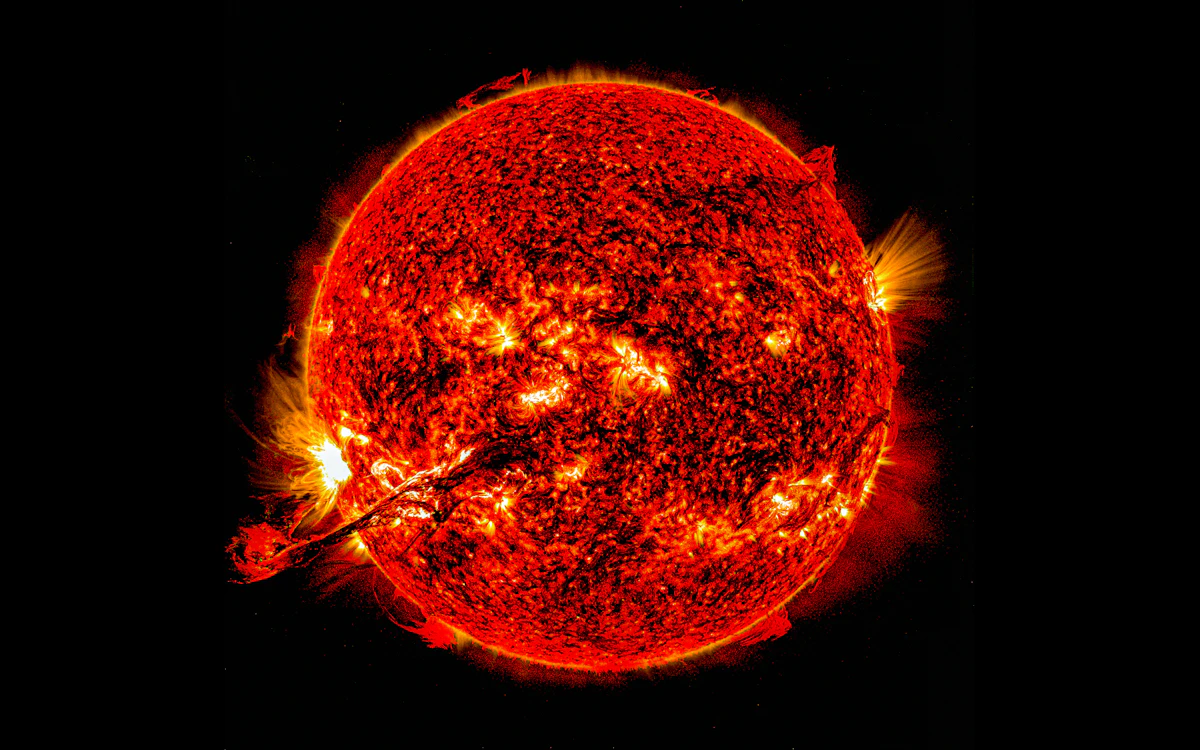
A solar flare is a sudden release of magnetic energy on the Sun’s surface, visible as a bright flash in X-rays and ultraviolet light. A coronal mass ejection is different: it’s a cloud of plasma and magnetic field that shoots out from the Sun and can take between 15 and 18 hours to reach Earth if it travels fast, or several days if it’s slower. Both phenomena often occur together, but not always.
Context and history: half a century watching the Sun
The precedent every space weather specialist cites is the Carrington Event of 1859, a geomagnetic storm so intense it set telegraph lines on fire through electrical induction. Without satellites or modern electronics, the damage was limited. An equivalent event today, with power grids and satellites dependent on sensitive electronics, would be far more costly.
The most cited modern example is the 1989 Quebec blackout, caused by a geomagnetic storm that induced electrical currents in grid transformers and left millions of people without power for hours. Since then, space weather monitoring has become an operational priority, not just a scientific one.
GOES satellites, operated by NOAA since the 1970s, measure the Sun’s X-ray flux in real time and confirm a flare the instant it occurs. The ACE (1997) and DSCOVR (2015) probes, located at the L1 Lagrange point about 1.5 million kilometers from Earth, directly measure the solar wind before it arrives, giving between 15 and 60 minutes of warning once the ejection is already on its way. NASA’s Solar Dynamics Observatory, in orbit since 2010, provides the missing piece: its HMI instrument captures continuous magnetograms of the entire solar disk, the raw material that now feeds this type of AI model.
Technical details and performance
The principle behind this type of model is to treat the sequence of magnetograms as a time series: instead of looking at a single image of the solar magnetic field, the model observes how that topology changes minute by minute. Sudden changes in magnetic shear or in flux emergence often precede a flare, and that’s the pattern a model trained on enough history can learn to recognize before the event shows up as an X-ray flash.
In flare prediction literature, the standard metric for reporting performance is the True Skill Statistic (TSS), which compares hits and false positives against a random prediction. There’s no confirmed performance figure for this particular model in the available coverage, so any concrete numerical comparison will have to wait until the original study and its operational validation are available.
| Method | What it measures | Warning window | Limitation |
|---|---|---|---|
| X-rays (GOES) | Real-time X-ray flux | Nearly none, confirms in the moment | Only detects the flare once it has started |
| Solar wind at L1 (ACE/DSCOVR) | In situ solar wind density and speed | 15 to 60 minutes | The CME is already traveling toward Earth |
| MHD models (WSA-Enlil) | Physical simulation of CME propagation | Hours to days | High computational cost, error in arrival time |
| AI on magnetograms (new approach) | Patterns in magnetic field topology before the flare | Hours | Risk of false positives, depends on SDO/HMI data quality |
⚠️ Heads up: a predictive model trained on historical data can generate false positives. Real operational validation happens when NOAA compares its alerts against events confirmed by GOES over months, not in a single lab test.
How to start exploring solar data
You don’t need to wait for this specific model to be published to experiment with real solar data. NASA’s DONKI API exposes flares, coronal mass ejections, and geomagnetic storms in JSON format, with a free demo key.
curl "https://api.nasa.gov/DONKI/notifications?type=FLR&api_key=DEMO_KEY"That command returns recent solar flare notifications recorded by NASA, in JSON format, without needing to register yet.
import requests

response = requests.get(
    "https://api.nasa.gov/DONKI/CME",
    params={
        "startDate": "2026-08-01",
        "endDate": "2026-08-14",
        "api_key": "DEMO_KEY",
    },
)

for event in response.json():
    print(event["activityID"], event.get("note", ""))
This Python script lists the coronal mass ejections recorded by NASA in that date range, showing the event identifier and the analyst’s note that catalogued it. It’s the same type of raw data that would feed a prediction model like the one described in the news.
💡 Tip: NASA’s DEMO_KEY has a low rate limit per hour. To work seriously, register a free personal key at api.nasa.gov.
NOAA, for its part, maintains public JSON feeds at swpc.noaa.gov, the source used by power grid operators and airlines for real-time operational decisions.

Impact and analysis
A few extra hours of warning aren’t a minor detail for anyone operating critical infrastructure. Satellite operators can put sensitive instruments into safe mode before energetic particles hit. Airlines flying polar routes can reroute traffic before a high-frequency radio blackout, instead of reacting mid-flight.
Power companies are perhaps the biggest beneficiaries: a geomagnetic storm induces currents in high-voltage transformers, the same mechanism that caused the 1989 Quebec blackout. With hours of margin, a grid operator can adjust loads or put critical equipment into protection mode before the induced current causes physical damage to the transformer, which in some cases is irreparable.
This development also fits into a broader trend: science is starting to use AI not just to process data, but as a reasoning tool for complex phenomena. MIT Technology Review documented this discussion in its analysis “AI for science needs reasoning, not just data”, which argues that AI’s real value in science comes when the model reasons about the phenomenon, not just when it finds correlations in a dataset.
What’s next
The natural next step for a model like this is operational validation: having NOAA SWPC run it in parallel with its current tools for months, comparing each early alert against what GOES’s X-ray sensors ultimately confirm. Only that process, sustained over time, allows for calculating a reliable false positive rate.
The other factor in its favor is timing: the Sun is near the maximum of solar cycle 25, with more activity and therefore more events to train and test any model. The more real flare examples SDO captures in this window, the faster it will be possible to know whether the approach works at operational scale.
flowchart TD
    A["SDO / HMI: magnetograms"] --> B["AI model"]
    B --> C["Early warning"]
    C --> D["NOAA SWPC"]
    D --> E["Operators: satellites, grids, airlines"]
Try it yourself: request a free key at api.nasa.gov and query the DONKI/CME endpoint to see the latest solar events NASA catalogued this week.
Frequently Asked Questions
What is a solar flare?
It’s a general term covering two related phenomena: the solar flare itself, a flash of magnetic energy on the Sun’s surface, and the coronal mass ejection, a cloud of plasma shot out into space.
What’s the difference between a flare and a coronal mass ejection?
The flare is light and radiation, it travels at the speed of light and reaches Earth in minutes. The coronal mass ejection is physical matter, plasma and magnetic field, and takes between 15 hours and several days to arrive, depending on its speed.
Why do a few hours of warning make such a difference?
Because they allow action before impact: putting satellites into safe mode, rerouting polar flights, or protecting electrical transformers, instead of reacting once the damage has already begun.
Is NASA and NOAA’s solar data free?
Yes. NASA’s DONKI API and NOAA SWPC’s JSON feeds are public and don’t require payment, though it’s worth registering a personal key for continuous use.
Does this replace NOAA’s current systems?
No, at least not yet. A model like this would add to existing tools, such as GOES sensors and the L1 probes, after a period of operational validation.
When will this type of model be operational?
The available coverage doesn’t give a concrete date. The usual practice in space weather forecasting is a trial period running in parallel with current systems before declaring a model operational.
References
- Phys.org (via MSN): original report on the AI model that detects signals ahead of solar flares
- NOAA Space Weather Prediction Center: U.S. operational center for space weather alerts
- NASA Solar Dynamics Observatory: the mission that captures the magnetograms used for this type of model
- NASA API (DONKI): public access to flare and coronal mass ejection data
- MIT Technology Review: analysis on AI’s role as a scientific reasoning tool
📱 Like this content? Follow @programacion on Telegram for daily tech content in Spanish: quick summaries, fresh content every day. @programacion
Imagen destacada: Foto de NASA Hubble Space Telescope en Unsplash
Did it work for you? Got a different error? Say so below: questions get answered and help the next reader.
Leave a comment


0 Comments