⏱️ Reading time: 9 min
Johns Hopkins University confirmed on November 2, 2026, that it handed over its cancer cell mapping technology to an Anthropic artificial intelligence project. The university did not disclose the platform’s commercial name or the deal’s financial terms, but it did state the goal: for an AI model to help interpret biological data at a resolution that, until recently, only specialized computational biology teams could analyze.
📑 En este artículo
- TL;DR
- What the cancer cell mapping platform is
- What happened
- Context and history
- Technical details: how cell mapping works and what it brings to AI
- Impact and analysis
- What’s next
- Frequently Asked Questions
- What exactly is the cancer cell mapping technology Johns Hopkins is handing over?
- Will Anthropic train Claude with this data?
- How is this technology different from single-cell sequencing?
- Do patients authorize the use of their data for this type of project?
- When will results of the cancer cell mapping project with Anthropic be known?
- References
The announcement comes amid a wave of artificial intelligence labs seeking high-quality scientific data to train and test their models, a trend that has already driven similar initiatives in genomics, chemistry, and materials science.
TL;DR
- Johns Hopkins handed over its cancer cell mapping platform to an Anthropic artificial intelligence project, confirmed on November 2, 2026.
- The technology records the exact position of each tumor cell within the tissue, not just its genetic type.
- Anthropic already operates products aimed at life sciences, as part of its broader bet on AI applied to research.
- The stated goal is for an AI model to detect cellular patterns that traditional methods can’t capture at the same resolution.
- Neither institution disclosed funding amounts, a timeline, or whether the data will train models or only be analyzed by them.
What the cancer cell mapping platform is
The cancer cell mapping platform is a set of spatial biology techniques that records which genes activate in each tumor cell and the exact position where it sits within the tissue, unlike methods that analyze isolated cells without their physical context.
Johns Hopkins did not reveal the commercial name of its version of this spatial mapping technology in the November 2 announcement, but it did confirm that it was chosen to be integrated into an Anthropic artificial intelligence project focused on oncology research.
This type of agreement is uncommon. Data from this kind of tumor cell mapping usually stays within academic consortia rather than crossing over to companies that train large-scale language models.
What happened
Johns Hopkins’ statement describes the handover as part of a joint artificial intelligence for science project, without specifying whether Anthropic receives the raw data, models already trained on that data, or both. The university also did not specify which Anthropic product line absorbs the project.
What is clear is the role each party plays: Johns Hopkins contributes the technology and the tumor tissue samples, while Anthropic provides the AI model tasked with finding patterns in that data. Neither institution mentioned a published result yet, nor a date for sharing one.
The lack of concrete figures on funding, sample count, and project timeline leaves several open questions that will only be resolved if either party expands on the original statement.
Context and history
Johns Hopkins has a long track record in cancer genomics. Its Kimmel Center was one of the places where the foundations of tumor sequencing were laid more than two decades ago, and the university has since maintained several labs dedicated to mapping mutations and gene expression in tumor tissue.
Spatial mapping technology itself is younger. The first single-cell sequencing techniques date back to 2009, but it wasn’t until 2016 that the first methods arrived that also preserved each cell’s location within the tissue slice. Before that, analyzing a tumor meant grinding it up and averaging the genetic signal of thousands of mixed cells, losing any information about their actual arrangement.
Anthropic, for its part, has been expanding its presence beyond pure software. The company already offers products geared toward life sciences and takes part in agreements with labs and research centers, in what it describes as a bet on accelerating scientific discovery with language models. The Johns Hopkins deal adds to that list, though it’s one of the first focused specifically on oncology cell mapping data.
This move isn’t exclusive to Johns Hopkins and Anthropic. Academic institutions and public agencies in several countries have been exploring similar agreements to have AI models analyze high-resolution biological data, from genomics to medical imaging, though most of these agreements are still in early stages and few have published verifiable results.
Technical details: how cell mapping works and what it brings to AI
The mechanism behind this family of techniques combines microscopy and sequencing. A thin tumor tissue slice is fixed onto a special slide and exposed to probes that bind to specific RNA transcripts or to fluorescently labeled antibodies. A scanner captures thousands of images of the same slice, and a segmentation algorithm assigns each detected signal to the most likely neighboring cell within the tissue.
The final result isn’t a list of genes, but a map: each cell is tagged with its molecular profile and exact coordinates, and the software can reconstruct which cell types are in direct contact with one another. That neighborhood information is what interests an AI model, because a tumor’s behavior depends as much on the mutations it accumulates as on how those cells interact with the immune system and the healthy tissue around them.
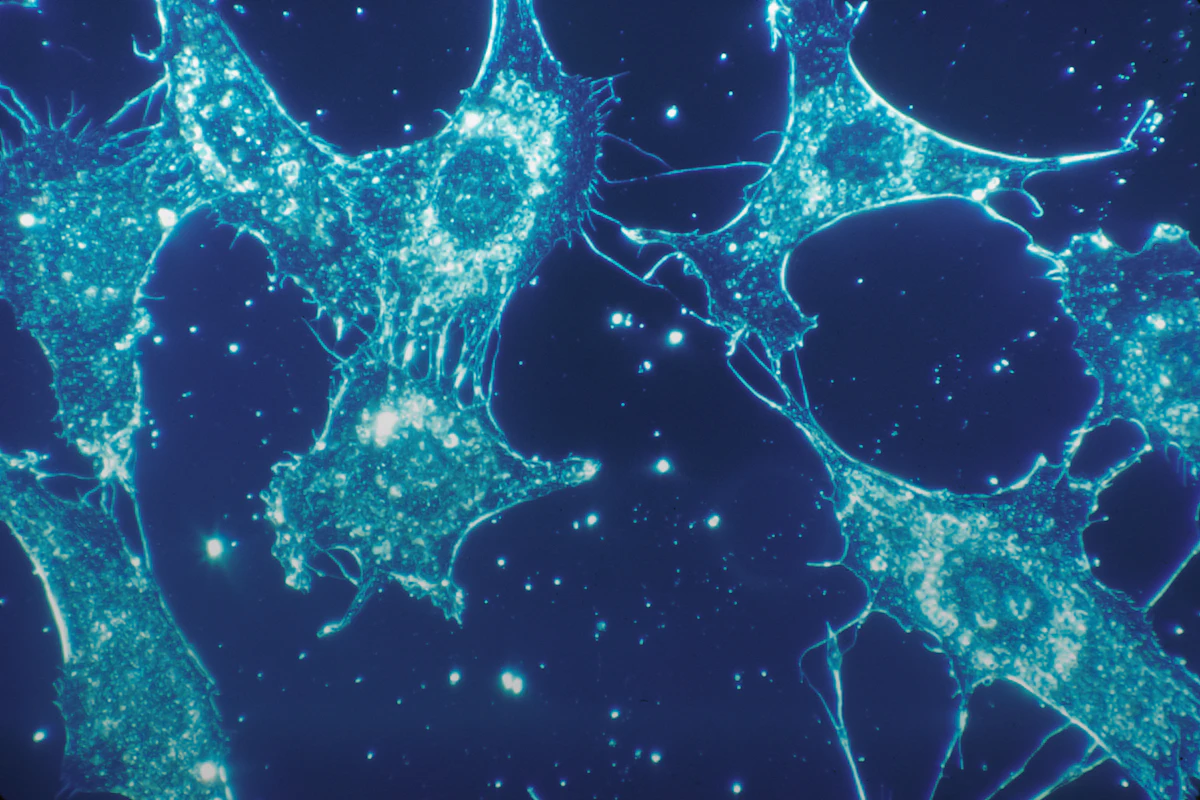
Processing this kind of data is costly. A single sample can generate several gigabytes of high-resolution images, and reconstructing the complete cell map requires specialized computing hardware before any language model can analyze it. That preprocessing cost is exactly what makes an already mature platform like Johns Hopkins’ valuable: building one from scratch would take any AI lab years of purely biological work.
flowchart TD
    A["Tumor biopsy"] --> B["Cell mapping platform"]
    B --> C["Cell map with coordinates"]
    C --> D["Anthropic AI model"]
    D --> E["Candidate patterns"]
    E --> F["Lab validation"]
The diagram summarizes the path each sample follows: first it goes through the tumor’s spatial biology platform, then the AI model looks for correlations in that map, and any finding still needs to be confirmed with traditional experiments before it can be considered valid.
Which cell mapping method to use depending on the goal
| Method | What it measures | Advantage | Limitation |
|---|---|---|---|
| Single-cell sequencing (scRNA-seq) | Gene expression per cell, without location | High genetic resolution per cell | Loses spatial position within the tissue |
| Spatial transcriptomics | Gene expression with tissue coordinates | Preserves the tumor’s anatomical context | Lower read depth per measured point |
| Multiplexed imaging (CODEX-type) | Specific proteins with exact location | Protein resolution at the single-cell level | Limited to a fixed panel of markers |
| Multimodal AI model | Combined patterns across the three previous sources | Finds correlations a human eye can’t detect | Needs subsequent experimental validation |
Impact and analysis
For Anthropic, adding cancer cell mapping data fits a broader strategy: turning language models into useful tools for biomedical research, a field where other AI labs and academic centers also compete for access to quality biological data. Having access to a platform already validated at a medical center like Johns Hopkins saves the company the most expensive step: building or buying its own cell mapping infrastructure.
For Johns Hopkins, the agreement opens a collaboration path different from traditional grant and public subsidy funding. But it also raises questions the statement doesn’t answer: what controls exist over the subsequent use of patient data, and whether the AI model’s findings will be published in peer-reviewed journals or remain joint property of both institutions.
💭 Key point: an AI model trained on data from a single hospital can mistake traits specific to that institution, like the staining protocol or the scanner used, for real biological signals from the tumor, a problem known in computational biology as batch effect.
This risk isn’t exclusive to this project, but it’s why an AI model’s findings on this oncology cell atlas need to be replicated in tissue from other centers before they can be considered reliable. Finding a statistical pattern in the data doesn’t prove that pattern has a real biological cause: that step still requires traditional lab work, something no language model replaces for now.
What’s next
Johns Hopkins and Anthropic haven’t set a date to show concrete project results. They also haven’t clarified whether the agreement will extend to other medical areas beyond oncology, or whether other universities will be able to add their own cell mapping data in the future.
Judging by similar moves from other AI labs in biology, the most likely outcome is that the first visible result will be a paper or a joint technical report, rather than a commercial product. Until that happens, the only confirmed fact is the original announcement: a university handed over its tumor cell mapping technology, and an AI company committed to analyzing it.
If you want to check the original source before any summary, Johns Hopkins’ full statement has been available on the university’s website since today.
Frequently Asked Questions
What exactly is the cancer cell mapping technology Johns Hopkins is handing over?
It’s a spatial biology technology that records which genes or proteins each tumor cell expresses and its exact position within the tissue, instead of analyzing a mix of cells without location.
Will Anthropic train Claude with this data?
Johns Hopkins’ statement doesn’t specify. It’s not clear whether the data is used to train a model, to evaluate one, or only for an already-trained model to analyze it on a case-by-case basis.
How is this technology different from single-cell sequencing?
Single-cell sequencing measures each cell’s gene expression separately, but loses its original position in the tissue. Spatial mapping preserves that location, which makes it possible to study how neighboring cells interact within the tumor.
Do patients authorize the use of their data for this type of project?
Studies with human tissue require passing through institutional ethics committees and anonymizing samples, though Johns Hopkins didn’t detail the specific protocol that applies to this project with Anthropic.
When will results of the cancer cell mapping project with Anthropic be known?
Neither institution set a date. The original statement only confirms the start of the collaboration, with no timeline for results.
References
- Johns Hopkins Hub: official announcement of the cell mapping technology handover to an Anthropic project.
- Nature: overview of the rise of artificial intelligence applied to scientific research.
- Wikipedia: general explanation of spatial transcriptomics techniques and their history.
- Anthropic: the company’s official site and its product lines geared toward scientific research.
📱 Do you like this content? Follow @programacion on Telegram for daily tech content in Spanish: quick summaries, fresh content every day.
Featured image: Foto de Logan Gutierrez en Unsplash
How each article is made (sources, testing and editorial criteria): How we work.
Did it work for you? Got a different error? Say so below: questions get answered and help the next reader.
Leave a comment



0 Comments